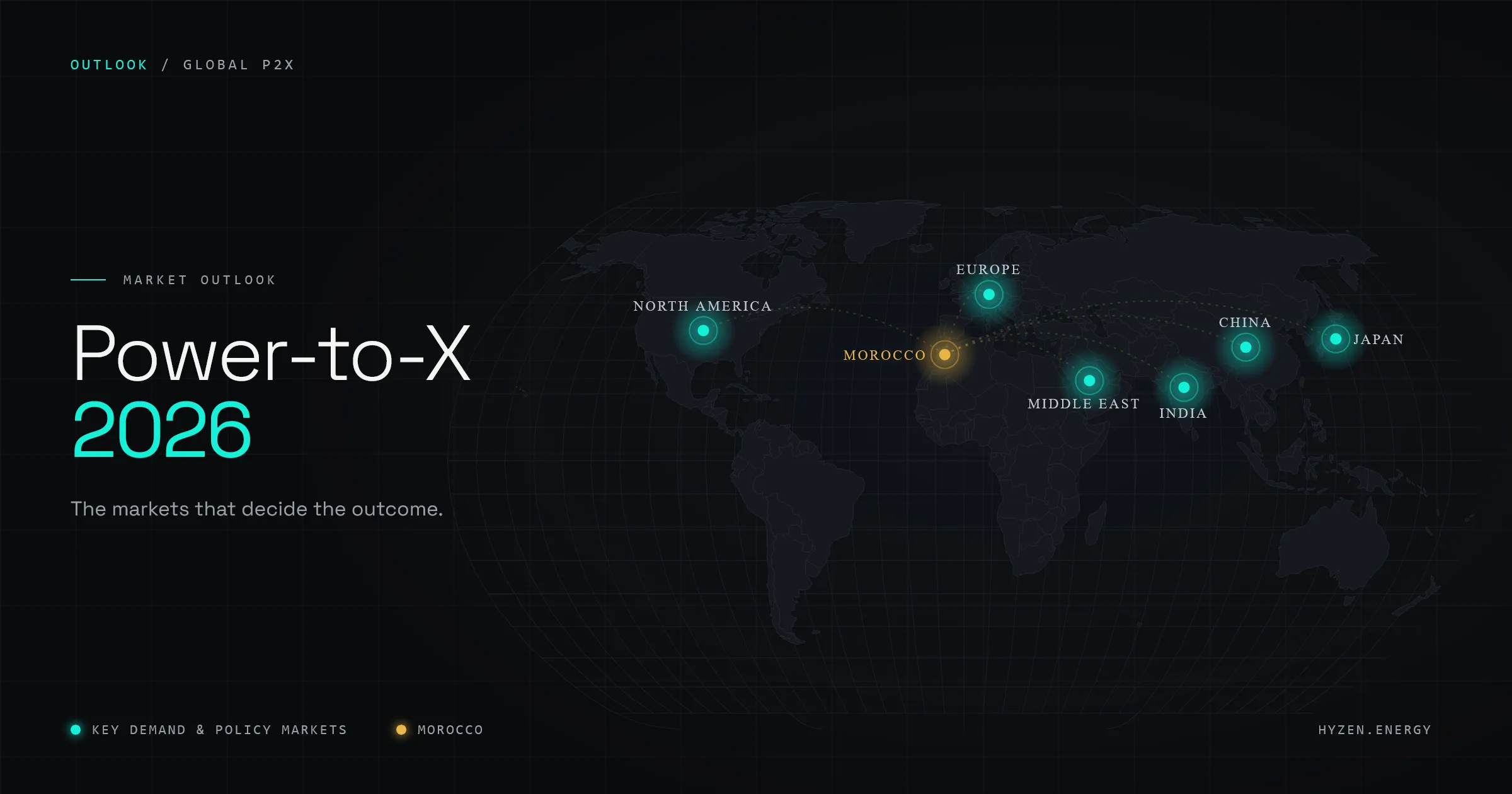
The Power-to-X market in 2026 has two sides. The sector is growing at its fastest pace yet, and it is still delivering less than the industry announced. Low-emissions hydrogen production rose 20% in 2025 to almost 1 million tonnes, and it is on track to pass 1% of global hydrogen production in 2026. At the same time, the pipeline of announced projects for 2030 has shrunk by 10 million tonnes, to 27 million.
This article covers the headline numbers, the markets that will decide the outcome, and what to watch next. Unless noted, figures come from the IEA's Global Hydrogen Review 2026.
What Power-to-X Means
Power-to-X (PtX) turns renewable electricity into hydrogen, then into products such as ammonia for fertiliser, methanol for shipping and chemicals, and synthetic kerosene for aircraft. Ammonia and methanol alone make up roughly half of today's global hydrogen consumption. PtX is not a new product category; it is a new way to make products that industry already buys at scale.
The 2026 Numbers at a Glance
| Metric | 2025 result | 2026 trajectory |
|---|---|---|
| Low-emissions hydrogen production | ~1 million tonnes | On track to pass 1% of global supply |
| Installed electrolysis capacity | >4 GW (doubled in 2025) | +2.5 GW under construction |
| Capital investment | ~$7 billion | Approaching $10 billion |
| Electrolysis share of investment | ~70% | N/A |
| Investment as % of global energy supply | 0.7% | N/A |
| Announced 2030 pipeline | 27 million tonnes | Down 10 Mt from prior year |
| Committed 2030 production | 4.3 million tonnes | Up to 6 Mt if strong candidates reach FID |
| New offtake agreements (2025) | ~1.7 million tonnes | ~20% firm |
Research firms publish "market size" figures that differ widely: Future Market Insights puts the 2026 PtX market at $256.8 million, while Mordor Intelligence estimates $468 million. These figures count different things, so check the scope before quoting either.
The Markets That Decide the Outcome
China: The Volume Leader, Now Consolidating
China was behind nearly three-quarters of new electrolysis installations in 2025 and holds more than 60% of committed global electrolysis capacity by 2026. It is also one of only two countries, alongside the Netherlands, on track to meet its 2030 hydrogen target. The IEA expects renewable hydrogen in China to become cost-competitive without subsidy by 2030.
But growth is slowing. New final investment decisions (FIDs) fell for the first time in 2025, and excess manufacturing capacity is pushing electrolyser makers into consolidation: some are reportedly offering product below manufacturing cost. New support schemes introduced in the second half of 2025 should revive investment. One example is a $1.1 billion city-clusters programme targeting an end-use hydrogen price of $3.6/kg, with $2.2/kg as a stretch goal, by 2030.
Europe: The Regulatory Market
Europe is where demand is written into law, which makes it structurally different from every other market.
RED III requires 42% of hydrogen used in industry to be renewable in origin by 2030, rising to 60% by 2035. By early June 2026, 13 member states had transposed the transport-sector rules, creating binding demand for more than 575,000 tonnes of low-emissions hydrogen per year. Around 2 GW of new electrolysis capacity is expected in Europe in 2026, concentrated in a small number of large projects. Slow national-level policy implementation is still delaying scale-up, and project cancellations have reduced spending.
ReFuelEU adds an aviation mandate: synthetic aviation fuel must average 1.2% of supply across 2030 and 2031. Airlines are pushing for delay or repeal, and a formal review is due in 2027. That review is the key policy event to watch for the synthetic kerosene segment of PtX.
North America: Projects Built for Export
The IEA notes that some large North American projects based on carbon capture have reached FID. Most projects under development are aimed at overseas markets, so their bankability depends on demand created abroad, primarily by Japanese and EU policy. The IEA notes that recent policy developments in the region have increased uncertainty for developers.
Japan and India: The Demand Pull in Asia
Japan had selected six winners under its contracts-for-difference scheme by late May 2026, adding up to nearly 130,000 tonnes per year of low-emissions hydrogen. Two of those contracts support ammonia imports for power generation, the clearest signal yet that ammonia co-firing is moving from demonstration to commercial contract.
In India, solar-agency tenders and refinery projects have produced offtake contracts, though whether all of them proceed depends on incentive structures that are still being finalised. India has also set emission thresholds for qualifying renewable ammonia and methanol, establishing the product definitions that procurement contracts will reference.
The Middle East: Export Scale Under Stress
Saudi Arabia's NEOM project defines what export-scale PtX looks like in practice. It is designed to produce up to 600 tonnes of hydrogen per day, converted into up to 1.2 million tonnes of green ammonia per year, with first product planned for 2027. Air Products holds a 30-year offtake agreement for the full output, yet converting that offtake into end-buyer contracts at competitive prices has proved difficult.
The wider region carries outsized weight in global molecule markets. The Middle East holds approximately one-sixth of global hydrogen production, over a quarter of global ammonia trade, and nearly 45% of methanol trade. The 2026 regional conflict and the temporary closure of the Strait of Hormuz severely disrupted that trade, a reminder that hydrogen's role in energy security is not only about new supply, but about the resilience of existing commodity flows.
Africa and Latin America: Large Resources, Limited Finance
Africa produces only about 6,000 tonnes of low-emissions hydrogen today. Of the 31 projects announced for 2030, just 1 has reached FID. High financing costs are the primary barrier, not resource quality. In Latin America, Chile revised its national hydrogen target downward, reflecting the same tension between ambitious announcements and the financing realities of early-mover projects.
Morocco is the notable exception worth watching. Preliminary land agreements for green hydrogen projects and H2Global's designation of Morocco as a frontrunner signal a credible export pipeline, backed by OCP Group's green investment programme. Whether that pipeline converts to FIDs in 2026-2027 will be a data point on whether African projects can close the financing gap at scale.
Trade Is the Wildcard
Trade would underpin over 40% of announced 2030 volumes if every project went ahead. Less than 8% of that, around 1 million tonnes, is operating, under construction, or committed today.
Long-term bilateral contracts dominate PtX trade structures, especially for ammonia and fertiliser. The infrastructure is already there: around 170 ammonia port terminals and 130 methanol port terminals are already operating globally.
Moving pure hydrogen by ship adds costs of approximately $2/kg and consumes over 30% of the energy content in the process. That energy penalty is why ammonia is the carrier of choice for long-distance hydrogen export: not a temporary convention but a thermodynamic reality. For the full LCOA methodology behind green ammonia export economics, see our green ammonia LCOA calculation guide.
The Demand and Cost Problem
Outside China, low-emissions hydrogen will remain more costly than fossil-based hydrogen in the near term. Without policy support, the price most offtakers can commit to is below $2/kg in most sector-and-region combinations. That is why quotas, contracts-for-difference, and public procurement matter more than incremental technology improvements at this stage of market development.
The first buyers are familiar names. Refineries and industrial plants are expected to consume 2.5 million tonnes by 2030, about 60% of committed production. The switching decision for these buyers is cost-driven, not values-driven. Policy bridges the gap.
For the underlying cost structure behind these thresholds, why $2/kg is the ceiling and what gets you there, see our electrolyzer CAPEX vs. discount rate analysis and capacity factor optimization.
What to Watch in 2026 and 2027
Investment decisions by early 2027. About 22 million tonnes of announced production may lose any realistic chance of operating by 2030 if FIDs slip past that point. The 2026-2027 window is not a soft deadline.
Firm offtake share. Of the 1.7 million tonnes of new agreements signed in 2025, only about 20% was firm. Watch whether that ratio improves. The gap between announced and binding offtake is the clearest leading indicator of whether the pipeline converts to physical production.
European transposition. Thirteen member states have transposed RED III transport rules. Watch the industrial-sector rules, which carry larger volume implications, and the 2027 ReFuelEU aviation review.
China's rebound. Will the new support schemes introduced in H2 2025 revive FIDs in 2026? China's FID trajectory effectively sets the floor for global electrolyser capacity additions this decade.
Energy security framing. The IEA says hydrogen can help diversify energy supply over the long term. Existing and committed production cannot ease today's pressures, but the regional disruption in the Middle East in 2026 demonstrated that commodity supply chains for ammonia and methanol are already politically exposed, which strengthens the long-term policy case for diversification.
The Bottom Line
The Power-to-X market in 2026 is growing quickly from a small base and concentrating in a few places. China leads on volume. Europe leads on regulatory demand creation. Japan leads on import contract structures. The Middle East leads on export scale. Everywhere else, projects depend on financing conditions and firm buyers that have not yet fully materialised.
For developers, the first decision is not which electrolyser to specify; it is where to build, and whether the resource, the policy environment, and the financing conditions align in one location. Those three factors determine whether a project reaches FID or joins the 22 million tonnes at risk of missing 2030.
Editorial Notes
Verified against full IEA source: All IEA figures come from the publicly available chapters of the Global Hydrogen Review 2026 (production, policy, trade, investment, cost acceptability, and key questions sections).
Gaps in regional coverage: The US policy environment (Inflation Reduction Act tax credit status), Australia, and Oman are not covered in detail. The IEA source material available provided limited 2026-specific detail on these markets. Add them with dedicated sourcing before expanding this article.
NEOM timing: Sources disagree, with commissioning estimates ranging from Q3 2026 to December 2026 and first ammonia in early 2027. First product date is stated here as "planned for 2027", the company's own public position.
Morocco items: The OCP investment programme dates from 2023-2027. Verify current status before using in client-facing deliverables.
Market-size reports: Future Market Insights and Mordor Intelligence figures are from publicly available headline pages. Full methodology is behind paywalls.
References
[1] IEA. Global Hydrogen Review 2026: Executive summary, Production, Policy, Trade and infrastructure, Investment and innovation, Cost acceptability, Key questions. https://www.iea.org/reports/global-hydrogen-review-2026/
[2] IEA Policies Database. Renewable Energy Directive III (RED III). https://www.iea.org/policies/27735-renewable-energy-directive-iii-red-iii-ghg-threshold
[3] Capstone DC. How the EU's Aviation Fuel Mandate Review Creates a Window for Airlines (2026). https://capstonedc.com/insights/how-the-eus-aviation-fuel-mandate-review-creates-a-window-for-airlines/; Carbon Gap. ReFuelEU policy tracker. https://tracker.carbongap.org/policy/refueleu-aviation/
[4] AGBI. NEOM green hydrogen project nears completion (February 2026). https://www.agbi.com/giga-projects/2026/02/neom-green-hydrogen-project-nears-completion/; Oil & Gas Middle East. NEOM reaches 90% completion (January 2026). https://www.oilandgasmiddleeast.com/news/neom-green-hydrogen-project
[5] Ecofin Agency. Morocco signs preliminary land agreements for green hydrogen projects. https://www.ecofinagency.com/news-industry/0902-52702-morocco-signs-preliminary-land-agreements-for-green-hydrogen-projects; Morocco World News. H2Global names Morocco a green hydrogen frontrunner (March 2026). https://www.moroccoworldnews.com/2026/03/281782/h2global-names-morocco-a-green-hydrogen-frontrunner/; OCP Group. OCP Group launches its new green investment program 2023-2027. https://www.ocpgroup.ma/news-article/ocp-group-launches-its-new-green-investment-program-2023-2027
[6] Sebbahi, S. et al. Modeling and techno-economic assessment of a 20 kW alkaline green hydrogen micro-pilot powered by hybrid solar-wind systems in Morocco. Journal of Power Sources 677 (2026) 240015. https://doi.org/10.1016/j.jpowsour.2026.240015
[7] Future Market Insights. Power-to-X Market. https://www.futuremarketinsights.com/reports/power-to-x-market; Mordor Intelligence. Power-to-X Market. https://www.mordorintelligence.com/industry-reports/power-to-x-market