
Curtailment
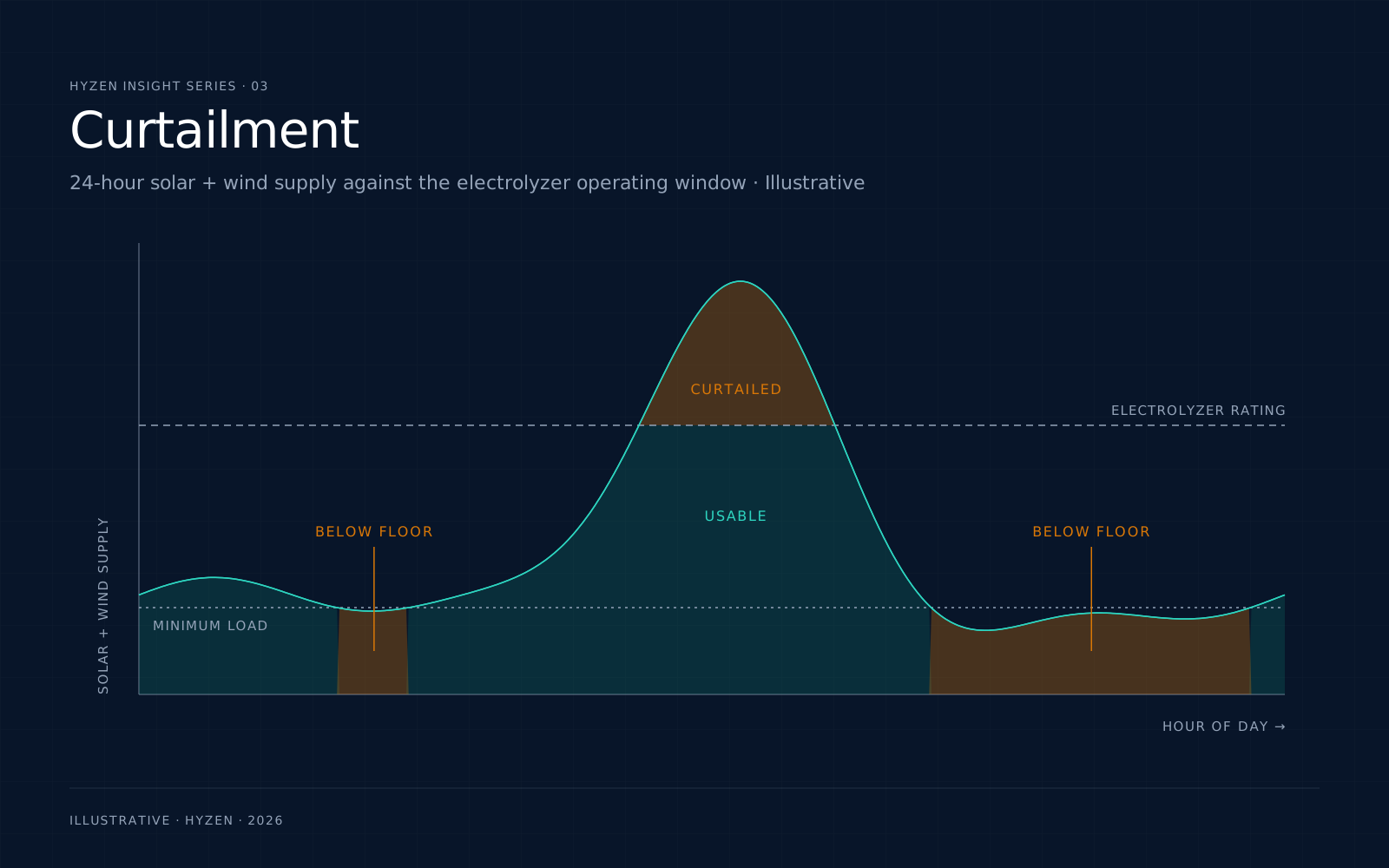
Curtailment in green hydrogen is renewable electricity a solar or wind plant could produce but the electrolyzer cannot absorb, because power is above its rating or below its minimum load.
In plain terms
In an off-grid plant, the renewable farm and the electrolyzer are rarely the same size. When solar or wind output rises above the electrolyzer's rating, the excess has nowhere to go. When output drops below the electrolyzer's minimum load, that energy is also lost unless a battery stores it. This wasted energy is curtailment, reported in MWh per year or as a share of possible renewable output.
The term comes from power systems, where curtailment is a cut in wind or solar output below what the resource could produce (NREL, 2014). On grid-connected plants, it can also be ordered by the grid operator.
Typical range
Curtailment in an off-grid hydrogen plant is a design outcome, not a property of a technology. It depends on the ratio of renewable to electrolyzer capacity, the solar-wind mix and any storage, so it is reported per project rather than as a general range.
Why it moves LCOH
Curtailment is linked to the electrolyzer capacity factor. Sizing the renewable plant larger than the electrolyzer fills more electrolyzer hours, which spreads electrolyzer CAPEX over more kilograms. It also raises the share of renewable output that cannot be used. A design study compares these two effects; the lowest-cost sizing does not have to be the one with zero curtailment.
Common mistake
Related terms
Further reading
Sources
- Wind and Solar Energy Curtailment: Experience and Practices in the United States, National Renewable Energy Laboratory (Bird, Cochran and Wang), NREL/TP-6A20-60983, 2014