
Capacity Factor (CF)
Electrolyzer capacity factor is the hydrogen a plant actually produces in a year divided by what it would produce running at full rated power every hour; it is one of the strongest levers on LCOH.
In plain terms
Two capacity factors matter in a green hydrogen plant, and they are often confused.
The renewable capacity factor is what the solar or wind farm delivers as a share of its peak rating over a year. The electrolyzer capacity factor is what the electrolyzer actually uses as a share of its own rating. They differ because the electrolyzer is usually sized smaller than the renewable plant, and because power below its minimum load or above its rating cannot be used.
A capacity factor is often expressed as full-load hours: 4,000 h out of 8,760 h is a capacity factor of about 46 %.
Typical range
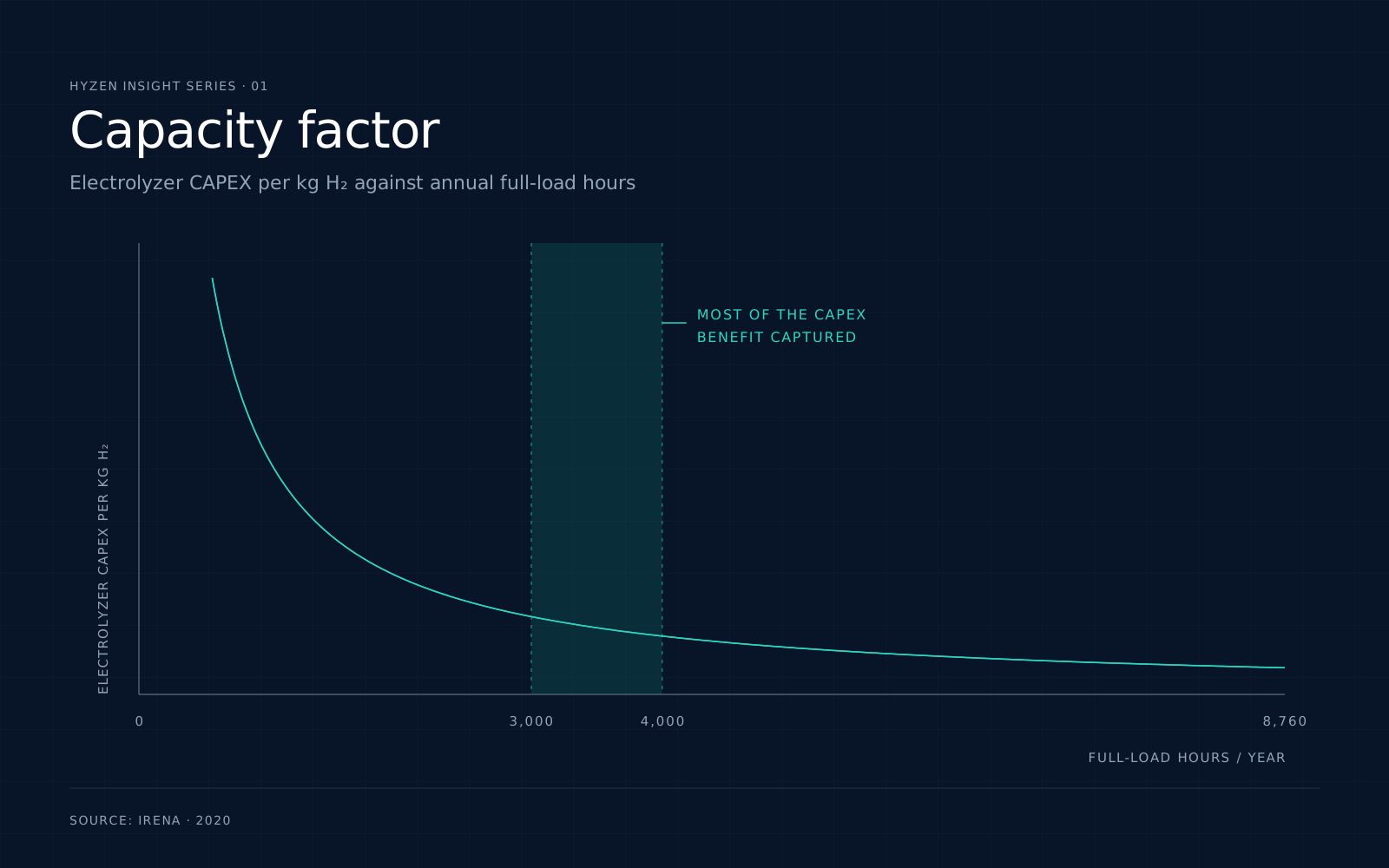
IRENA (2020) shows the capital-cost share of LCOH falling steeply as operating hours rise, with most of the benefit captured by about 3,000 to 4,000 full-load hours a year (34 to 46 %). Beyond that, extra hours still help, but more slowly.
Hybrid solar and wind sites reach higher factors than solar alone, because wind often blows when the sun is down. Sebbahi et al. (2026) report $3.18/kg for a Dakhla hybrid PV-wind case at a capacity factor of 50.85 %; this is a modelled, site-specific result, not a market price.
Why it moves LCOH
Electrolyzer CAPEX is a fixed cost spread over every kilogram produced. Halve the operating hours and the CAPEX per kilogram doubles. That is why site quality and solar-wind hybridisation can matter as much as electrolyzer price.
Common mistake
Typical range
3,000–4,000 full-load hours/year (≈34–46 % CF), where most of the CAPEX benefit is captured[1]
Related terms
Further reading
Sources
- Green Hydrogen Cost Reduction: Scaling up Electrolysers to Meet the 1.5°C Climate Goal, International Renewable Energy Agency (IRENA), 2020
- Sebbahi et al., Journal of Power Sources, Elsevier, 2026