
Europe has set a hydrogen target it cannot meet on its own soil. Under the REPowerEU plan, the EU aims to produce 10 million tonnes of renewable hydrogen a year by 2030 and to import another 10 million tonnes.
That import half explains why one phrase now appears in almost every ministerial statement on energy: the green hydrogen export corridor to Europe.
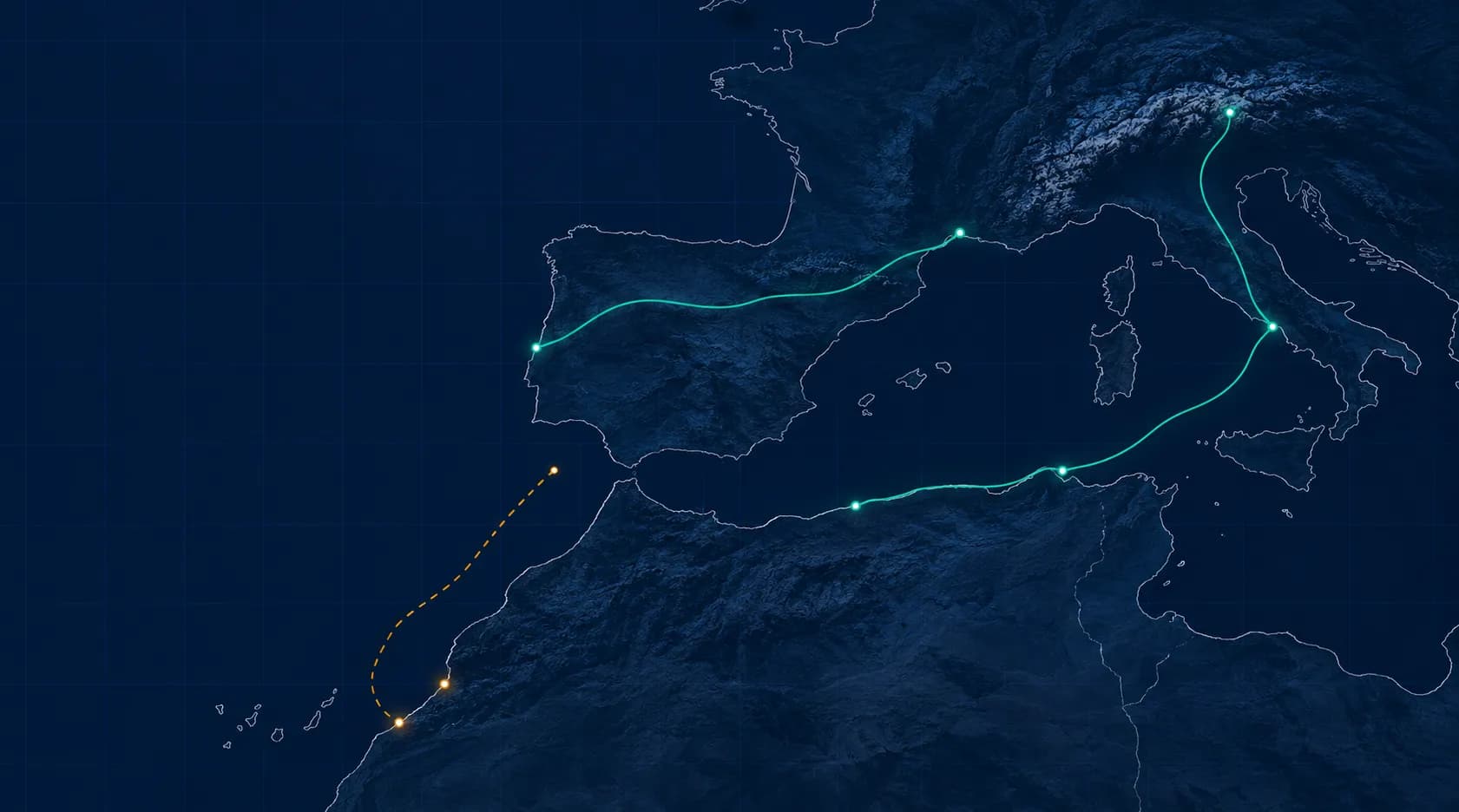
A corridor is the route between where hydrogen is cheap to make and where it is needed. On one side sit the sunny, windy coasts of North Africa and Iberia. On the other sit the steel mills, refineries, and chemical plants of Germany, Austria, and northern Italy. In between: pipelines, ports, ships, and years of permits.
This article explains where those corridors stand in October 2026, what moving hydrogen along them costs, and where Morocco fits.
What Europe Asked For, and the Reality Check
The Commission named three routes for those imports in 2022: the Mediterranean, the North Sea, and Ukraine once conditions allow. The Mediterranean route is the one that matters for North Africa.
The ambition drew criticism from inside the EU. In July 2024, the European Court of Auditors found that the production and import targets rested on political will rather than robust analysis, and judged them unlikely to be met by 2030.
Buyers are still showing up. In April 2026, the Commission closed the first round of its Hydrogen Mechanism, a platform that matches suppliers with European buyers. It drew 265 supply projects and 45 offtake projects, and 87% of suppliers received interest from at least one buyer. Those suppliers came from 33 countries, 16 of them EU members.
The picture, then: demand is real, the 2030 numbers are a stretch, and the delivery infrastructure is the bottleneck.
The Two Pipeline Corridors Taking Shape
Two southern pipeline corridors have moved from slideware to engineering. Neither is expected to carry hydrogen before the early 2030s.
| Corridor | Route | Planned capacity | Length | Target start | Latest milestone |
|---|---|---|---|---|---|
| H2Med | Portugal to Spain (CelZa), Spain to France (BarMar), onward to Germany | 2 Mt/year on BarMar | 670 km across both legs | 2032 | BarMar entered front-end engineering design on 16 July 2026 |
| SoutH2 Corridor | Algeria and Tunisia to Italy, Austria and Germany | Up to 4 Mt/year | ~3,000–3,300 km | Early 2030s | Five-country ministerial declaration signed in Algiers on 1 October 2026 |
H2Med is the more advanced of the two. The consortium puts the overall budget at about €2.85 billion. BarMar, the subsea link from Barcelona to the Marseille area, alone would carry about 10% of the hydrogen Europe expects to consume in 2030. In April 2026, the EU confirmed BarMar and CelZa as Projects of Common Interest, which opens access to EU infrastructure funding. Note the date drift: earlier materials targeted 2030; the consortium now says 2032.
SoutH2 is earlier in its life but has strong political backing. At the Algiers meeting, the partners set up a technical secretariat supported by UNIDO. In Italy, Snam plans to invest €200 million through 2030 in a 1,900 km national hydrogen backbone that would anchor the corridor.
The North Sea route works differently. It relies largely on ships and ports. The Port of Rotterdam, for example, announced an ambition in 2022 to supply 4.6 million tonnes of hydrogen to northwest Europe by 2030, much of it as ammonia.
Where Morocco Fits
Morocco has the resource, the policy, and the political ties. What it does not yet have is a line on either pipeline map.
The ties. In October 2022, Morocco became the first country to sign a Green Partnership with the EU, covering climate, energy, and the green economy.
The policy. The government launched the "Offre Maroc" for green hydrogen on 11 March 2024. On 6 March 2025, it selected five investors for six projects in the three southern regions, worth 319 billion dirhams in total, about $32.5 billion. Each project can receive up to 30,000 hectares, and the planned products are ammonia, steel, and industrial fuels. In September 2025, the steering committee approved preliminary land reservation contracts for those investors.
The cost. The IEA projects Morocco to have the lowest renewable hydrogen production cost in Africa, at around $3.2/kg. Our own research points the same way. Peer-reviewed research co-authored by Hyzen's founder, published in the Journal of Power Sources (Sebbahi et al., 2026), calculated a levelised cost of $3.18/kg for a hybrid solar-wind plant in Dakhla running at a 50.85% capacity factor, consistent with the methodology explained in our hybrid solar-wind system design analysis.
The gap. Morocco is not part of H2Med or SoutH2 today. The German-Moroccan Energy Partnership describes the country as a potential extension of H2Med. The export options on the table are a converted Maghreb-Europe gas pipeline, a new pipeline, or exporting green electricity by subsea cable instead of molecules. The fourth option, shipping ammonia, matches the products most Offre Maroc projects plan to make.
What the Corridor Adds to the Bill
A European buyer does not pay the production cost. It pays the landed cost: production, plus any conversion (to ammonia, for example), plus transport.
Transport is not small. H2Med's partners estimate that moving hydrogen from Spain to northwest Europe through their pipeline would add €0.60 to €1.00 per kilogram. For Morocco to Europe, IRENA has estimated transport at $2.05/kg by 2030, falling to $0.65/kg by 2050.
A simple illustration, not a forecast: take the $3.18/kg Dakhla production cost and add IRENA's 2030 transport estimate. The hydrogen reaches Europe at roughly $5.20/kg before conversion costs. With the 2050 transport estimate, the same molecule lands at roughly $3.83/kg.
Two lessons follow. First, a corridor cannot rescue a weak site. If production costs $7/kg, no pipeline makes it competitive. Second, the cheapest production site in the country is not automatically the best export site. Distance to the port or pipeline entry point matters as much as sunshine.
For the full LCOA methodology behind ammonia export economics, including the transport cost layer, see our green ammonia LCOA calculation guide.
What This Means for Project Developers
The corridors will not be ready before the early 2030s. A plant that reaches a final investment decision in 2027 or 2028 will be designed around an export route that does not yet exist. Three decisions follow from that.
1. Choose the product early. Pipeline hydrogen and shipped ammonia lead to different plants: different storage, different compression, different downstream equipment. The product decision belongs in pre-FEED, not after it.
2. Model the landed cost, not just the production cost. Compare sites on what the buyer will pay at the European border, including the transport leg. A $0.50/kg production cost advantage at a remote inland site can disappear entirely when transport to a port or pipeline entry point is included.
3. Plan for RFNBO certification from day one. Hydrogen counts toward EU targets only if it meets the EU's rules for renewable fuels of non-biological origin (RFNBO). Those rules shape how the plant draws its power (additionality, temporal correlation, geographic correlation), so they belong in the first design iteration, not in a compliance review after FID. For the full RFNBO framework, see our RFNBO & EU compliance category.
Europe has drawn its corridors. Morocco's place on that map will be decided by the projects that arrive with credible, documented numbers: production cost, transport cost, conversion cost, and RFNBO compliance status, all modeled together before FID.
Sources
- Freshfields. The Hydrogen Accelerator in REPowerEU: 10 Mt domestic + 10 Mt imports by 2030.
- HydroNews. REPowerEU confirms hydrogen targets, May 2022: three import corridors.
- Engineering News (Reuters). EU's green hydrogen goals not realistic, auditors say, July 2024.
- European Commission. First round of the EU Hydrogen Mechanism, 29 April 2026.
- Rigzone. Commission completes inaugural hydrogen matchmaking round, April 2026: 33 supplier countries.
- H2Med consortium. The H2Med project: length, capacity, budget, 2032 target, FEED milestone.
- Teréga. H2Med: BarMar project: BarMar = about 10% of expected 2030 EU consumption.
- Pipeline Journal. EU renews PCI status for H2Med, April 2026.
- gasworld. H2Med partners put transport costs at up to €1/kg, September 2026.
- Daily Sun. Five countries sign declaration to advance SoutH2 Corridor, October 2026: up to 4 Mt/year.
- HydroNews. SoutH2 partners meet in Algiers, 2 October 2026: UNIDO secretariat.
- Pipeline Journal. Snam to anchor SoutH2, March 2026: €200M, 1,900 km backbone.
- Ammonia Energy Association. REPowerEU and hydrogen imports, June 2022: Rotterdam 4.6 Mt ambition.
- European Commission. EU and Morocco launch first Green Partnership, 18 October 2022.
- TelQuel. Morocco selects 5 investors, 319 bn MAD, March 2025.
- Africa Energy Portal. Morocco approves $32.5B green hydrogen projects: USD conversion, 30,000 ha, products.
- FNH. Offre Maroc: 319 bn MAD validated, September 2025: land reservation contracts.
- German-Moroccan Energy Partnership (PAREMA). Green Hydrogen: IEA ~$3.2/kg; Morocco as potential H2Med extension.
- Sebbahi et al. Journal of Power Sources (2026): $3.18/kg Dakhla, CF 50.85%.
- CMS. Hydrogen law and strategy in Morocco: export options; IRENA transport cost estimates.