
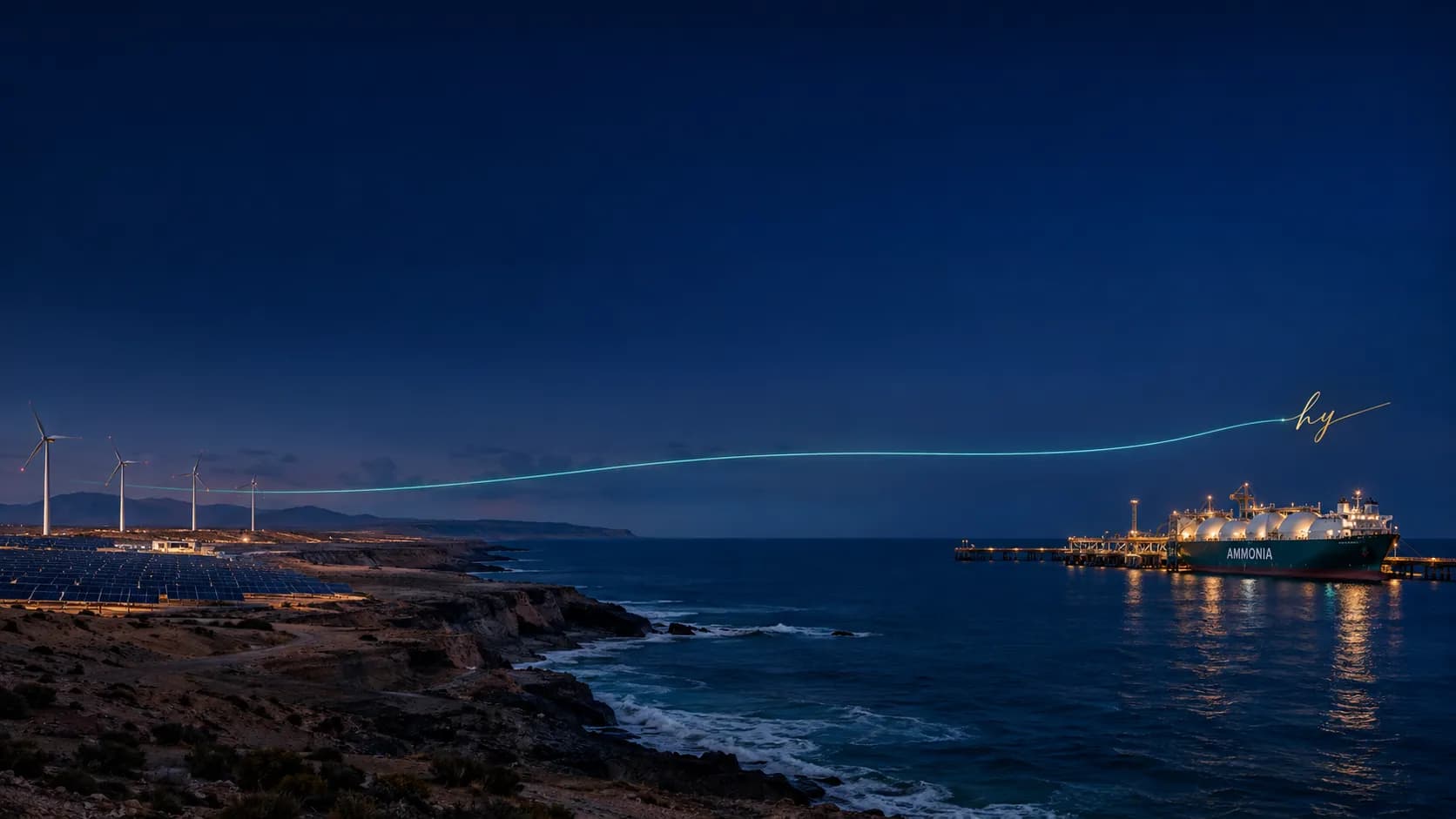
The hardest part of a green hydrogen project is no longer the electrolyser. It is finding someone who will sign a contract to buy the output.
The numbers make the point. According to the IEA's Global Hydrogen Review 2026, new offtake agreements for low-emissions hydrogen reached 1.7 million tonnes per year (Mtpa) in 2025, flat on 2024. Only one-fifth of those agreements were firm. The rest were preliminary deals: memoranda, letters of intent, and frameworks that no bank will lend against.
The IEA's conclusion is blunt: offtake agreements remain insufficient to unlock large-scale investment in low-emissions hydrogen production. Investment in new capacity is lagging because firm offtake is scarce.
So what does a bankable offtake agreement actually look like? This guide walks through the structure in plain language, using three real deals as examples.
What is a hydrogen offtake agreement?
A hydrogen offtake agreement is a long-term contract in which a buyer commits to purchase hydrogen, or a derivative such as ammonia or methanol, from a specific project. Lawyers sometimes call it a hydrogen purchase agreement (HPA).
In mature commodities, a producer can sell into a spot market. Hydrogen has no such market yet. As US law firm Norton Rose Fulbright puts it in its guidance for developers, without a merchant market a developer needs a long-term offtake contract to finance the plant at all.
That is why the offtake agreement matters more than almost any other document. Lenders look at it first. They size the loan on how long the contract runs and how much revenue is fixed. A strong contract unlocks cheap debt. A weak one leaves the project on paper.
The five building blocks of a hydrogen offtake agreement
Every offtake contract answers the same five questions. How each one is answered decides whether the deal is bankable.
| Building block | The question it answers | Why lenders care |
|---|---|---|
| Tenor | How many years does the buyer commit? | Debt is repaid over the contract life |
| Volume | How much must the buyer take, and what if they don't? | Fixed volume means predictable revenue |
| Price | How is the price set and adjusted? | Price must cover costs for the whole term |
| Product and certification | What exactly is being sold? | Off-spec or uncertified product can be rejected |
| Credit support | Who pays if the buyer can't? | A promise is only as good as the buyer's balance sheet |
1. Tenor: how long the contract runs
Freshfields suggests a long-term commitment of around 10 to 15 years. Some deals go much longer: the NEOM project in Saudi Arabia, covered below, has a 30-year contract. Norton Rose Fulbright notes that lenders tend to amortise debt over the length of the agreement, so a longer contract supports more debt.
2. Volume: take-or-pay
This is the core of most deals. Under a take-or-pay clause, the buyer agrees to a set quantity each period. It either takes that hydrogen and pays for it, or pays for whatever it did not take (Norton Rose Fulbright). A stricter variant, take-and-pay, obliges the buyer to take and pay for the full quantity.
Take-or-pay is borrowed from LNG, where it has long been standard. It creates a real tension, as UK firm Ashfords points out: firm volumes make a project bankable, but they can be unattractive to buyers who want flexibility.
3. Price: no benchmark to lean on
Oil, gas and power contracts can reference a market index. Hydrogen cannot. Australian firm Allens notes there is currently no market reference price or index for hydrogen offtake.
So early contracts usually build the price from the bottom up. Freshfields expects a formula combining fixed costs and variable costs, with any subsidy reflected in the price. Three adjustment tools then protect both sides:
- Indexation: part of the price moves with an input cost, such as electricity or natural gas benchmarks.
- Price review: the parties revisit the price at set intervals or after trigger events, as the market matures.
- Change in law: the price adjusts if new regulation raises or lowers costs.
4. Product and certification
For green hydrogen, the molecule is only half the product. The other half is proof that it is green. A buyer in Europe needs hydrogen that meets the EU's RFNBO rules (renewable fuels of non-biological origin), or it loses the regulatory value it is paying for. Contracts therefore specify purity, pressure, delivery point, and the certification the producer must hold.
5. Credit support
A take-or-pay clause is worthless if the buyer cannot pay. Norton Rose Fulbright advises project owners to look across their stakeholders for a creditworthy entity that can back-stop the obligation, such as a parent company guarantee or a state-backed intermediary. The next section shows how governments are stepping into that role.
Three structures shaping the market today
The building blocks are the same everywhere. What differs is who stands on the other side of the contract. Three models dominate.
| Structure | Who buys | Who covers the green premium | Real example |
|---|---|---|---|
| Bilateral long-term contract | A creditworthy industrial or trader | The buyer | NEOM Green Hydrogen, Saudi Arabia |
| Double auction with an intermediary | A state-funded intermediary, which resells | Government, through a contract-for-difference | H2Global, Germany |
| Production subsidy plus private offtake | A private buyer | Partly government (fixed premium per kg), partly the buyer | European Hydrogen Bank, EU |
Model 1: the bilateral long-term contract (NEOM)
The simplest structure is one producer, one strong buyer, one long contract. NEOM Green Hydrogen Company, a joint venture of ACWA Power, Air Products and NEOM, is the reference case.
In May 2023 the project reached financial close at a total investment of USD 8.4 billion, including USD 6.1 billion of non-recourse debt from 23 banks and institutions. The anchor was an exclusive 30-year agreement under which Air Products buys all the green ammonia the plant produces.
One detail shows how much risk a fixed-price contract can transfer. Ammonia Energy Association reported that the project's cost rose from its original USD 5 billion, yet the offtake price stayed at the level negotiated in 2020, for the full term. That is easier to accept when, as here, the buyer is also one of the project's three equal shareholders.
Model 2: the double auction (H2Global)
Germany's H2Global programme solves a different problem: European buyers are not yet willing to pay the full cost of green molecules for ten years. So the state steps in as the middleman.
An intermediary, Hintco, buys hydrogen derivatives through a competitive tender on 10-year contracts at the lowest available price. It then resells them to end users in a separate tender. The gap between the higher purchase price and the lower sale price is covered by government funding, a contract-for-difference approach (German Federal Ministry for Economic Affairs).
The first tender, for renewable ammonia, was won in July 2024 by Fertiglobe with production in Egypt. Key figures:
- Delivered price: EUR 1,000 per tonne of ammonia into Europe; net price EUR 811 per tonne (Fertiglobe; BMWK)
- Implied hydrogen cost: less than EUR 4.50 per kg, according to the German ministry
- Volume: at least 259,000 tonnes between 2027 and 2033 (BMWK), starting at about 19,500 tonnes in 2027 and up to 397,000 tonnes cumulatively (Fertiglobe)
- Contract value: up to EUR 397 million
The award then cascaded down the supply chain. According to S&P Global, Scatec signed a 20-year offtake agreement with Fertiglobe for the Egypt Green Hydrogen project on the back of the H2Global award. One government-backed contract created a second, longer private contract upstream. That is the model working as intended.
Model 3: production subsidy plus private offtake (European Hydrogen Bank)
The European Hydrogen Bank does not buy anything. It pays producers a fixed premium for each kilogram of RFNBO hydrogen produced, for up to 10 years (Clean Hydrogen Observatory). The producer still has to find its own buyer.
The second auction shows why that last step matters. In May 2025 the Commission selected 15 projects for EUR 992 million in support, with premiums of EUR 0.20 to 0.60 per kg for general projects (Hydrogen Europe). Yet by January 2026, S&P Global reported that grant agreements had been signed with only six projects, totalling EUR 270 million and 380 MW of electrolysis.
The third auction, published in May 2026, awarded EUR 1.09 billion to nine projects with almost 1.1 GW of electrolysis (S&P Global). An analyst quoted in that report noted that the winners will still need a significant premium from their offtakers.
A subsidy narrows the cost gap, but it does not replace a signed buyer.
What this means for Morocco
Morocco is building an export-led hydrogen sector, which makes offtake structure its central commercial question.
In March 2025, the government's steering committee for the Morocco Offer selected five investors to develop six projects worth MAD 319 billion across the three southern regions. Each project may receive up to 30,000 hectares of public land. In February 2026 the selected investors signed preliminary land reservation contracts, with a focus on green ammonia and industrial fuels.
Land, sun and wind are now secured on paper. The next milestone is a signed buyer. The global data shows why that step is the hard one:
- Nearly 45% of low-emissions hydrogen from announced projects worldwide is intended for export, yet only 5% of export-oriented projects have reached the investment stage (IEA, Global Hydrogen Review 2025).
- In 2025, trade-oriented offtake agreements outnumbered agreements for domestic use for the first time (IEA, Global Hydrogen Review 2026).
The second point is encouraging for Moroccan developers. Import demand from Europe is turning into contracts, and H2Global shows that a North African project can win a European tender. Egypt got there first. For the logistics side of that trade, see our analysis of green hydrogen export corridors to Europe.
Offtake terms shape the plant, not just the finances
This is where contract and engineering meet. A take-or-pay clause promises steady deliveries. Solar and wind produce variable power. Bridging that gap costs money: more renewable capacity, more electrolyser capacity, or more storage.
So the contract you sign changes the plant you should build. A tight delivery profile pushes the cost per kilogram up. A flexible one lowers it but may weaken bankability. Developers need to model both sides together, early, before they negotiate. Our article on electrolyzer capacity factor and LCOH optimization explains the plant-side trade-offs.
A five-question checklist before you negotiate
- Tenor: does the contract run long enough for lenders to repay the debt?
- Volume: what share of output is under take-or-pay, and can the plant actually deliver that profile from variable renewables?
- Price: is there a cost-based formula, plus indexation, price review and change-in-law protection?
- Certification: does the product meet the buyer's regulatory standard, such as the EU RFNBO rules, and who carries the cost if it doesn't?
- Credit: who backs the buyer's promise: a parent company, an intermediary like H2Global, or nobody?
The bottom line
The world is not short of hydrogen projects. It is short of signed buyers. The IEA counts 1.7 Mtpa of new offtake agreements in 2025, and only one in five was firm.
The deals that do close share a pattern. They run for a decade or more, fix most of the volume, build the price from costs, and put a strong balance sheet behind the buyer. Where the private buyer is not yet strong enough, governments are stepping in through intermediaries and subsidies.
For Moroccan developers, the opportunity is real and the first land is reserved. The projects that move first will be the ones that treat the offtake agreement as an engineering input, not a legal afterthought.
Model the contract before you sign it. Hyzen lets you test how tenor, take-or-pay level and delivery profile change your plant design and your cost per kilogram.
References
[1] IEA. Global Hydrogen Review 2026: Demand. International Energy Agency (2026).
[2] IEA. Global Hydrogen Review 2025: Trade and infrastructure. International Energy Agency (2025).
[3] Norton Rose Fulbright. Key issues for hydrogen developers. Project Finance NewsWire (2023).
[4] Norton Rose Fulbright. Negotiating hydrogen contracts. Project Finance NewsWire (2021).
[5] Freshfields. Four things to consider in a green Hydrogen Purchase Agreement. Freshfields Sustainability Blog.
[6] Allens. Putting a price on hydrogen. Allens Insights (2022).
[7] Ashfords. Hydrogen offtake agreements: avoiding the pitfalls. Ashfords Insights.
[8] SWF Institute. With a Total Investment Value of $8.4 Billion, NEOM Green Hydrogen Company Completes Massive Financial Close. SWF Institute (2023).
[9] Ammonia Energy Association. NEOM project reaches financial close, 30 year offtake secured. Ammonia Energy Association (2023).
[10] German Federal Ministry for Economic Affairs and Climate Action. H2Global: first bidding round results. BMWK (2024).
[11] Fertiglobe. Fertiglobe chosen as winning bidder in H2Global pilot auction. Fertiglobe (2024).
[12] S&P Global. Fertiglobe wins first German H2Global green ammonia import tender at Eur1,000/mt. S&P Global Commodity Insights (2024).
[13] Clean Hydrogen Partnership. European Hydrogen Bank. European Hydrogen Observatory.
[14] Hydrogen Europe. Boosting renewable hydrogen: the Commission selects 15 projects to receive nearly €1 billion. Hydrogen Europe (2025).
[15] S&P Global. EC signs grants with just 6 projects under second hydrogen bank auction. S&P Global Energy (2026).
[16] S&P Global. EU third hydrogen bank awards Eur1.1 bil for 1.1 GW electrolysis. S&P Global Energy (2026).
[17] Hespress. Morocco selects 5 investors for 319 billion dirham green hydrogen projects in southern provinces. Hespress English (2025).
[18] Ecofin Agency. Morocco signs preliminary land agreements for green hydrogen projects. Ecofin Agency (2026).