
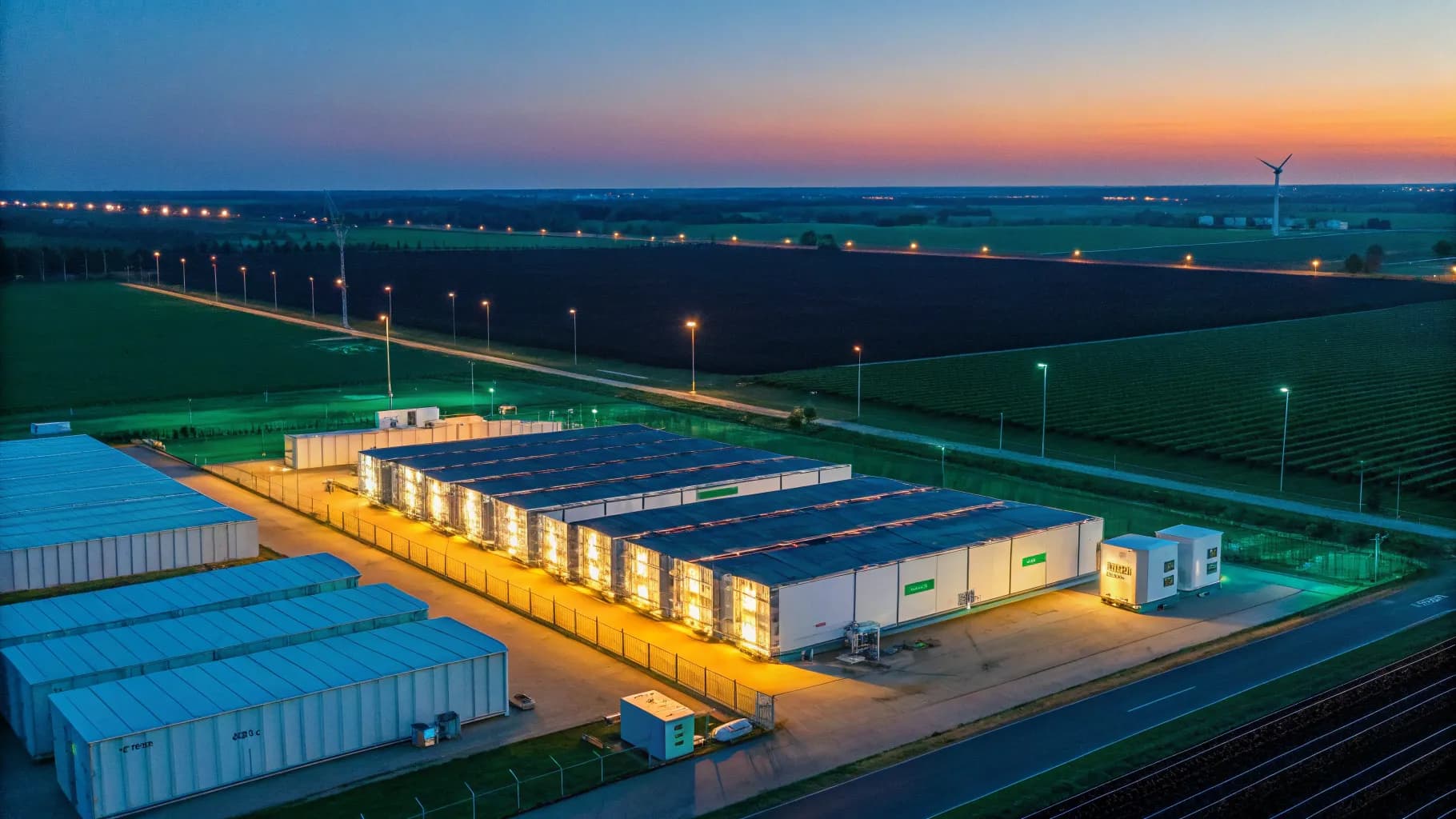
At 12:18 on 14 October 2026, a 60 MW / 120 MWh battery went live at CHN Energy's Guohua Rudong solar-hydrogen-storage complex in Jiangsu, China (FuelCellChina). It sits beside a 400 MW coastal PV plant and a 1,500 Nm³/h hydrogen plant sized for 482 tonnes of green hydrogen a year.
Here is the detail that matters for anyone sizing a project: that battery is dispatched by the Jiangsu power grid. It charges from surplus solar, discharges at peak demand and provides peak shaving. It is not a dedicated buffer for the electrolyzer.
That raises the question every developer and EPC team hits early in concept design. Does a green hydrogen plant need battery storage, how big should it be, and who is it really working for? Recent projects and 2026 studies give a clearer answer than they did two years ago.
What a battery actually does in a hydrogen plant
A battery in a green hydrogen plant can do three different jobs. Each one leads to a different size.
- Smoothing the electrolyzer's power supply. CHN Energy says the Rudong battery smooths PV fluctuations and provides a stable power supply for hydrogen production (pv magazine). This job is measured in minutes to a few hours.
- Earning grid revenue. At Marubeni's Bolivar project in South Australia, a 5 MW / 1 hour battery could feed a 160 kW PEM electrolyzer when power was expensive, or discharge to the grid at peak demand. Hydrogen production was mothballed as not commercially viable at that scale; the battery keeps earning from grid balancing and arbitrage (CSIRO HyResource).
- Keeping an off-grid system stable. Without a grid, something has to hold voltage and frequency and cover the gaps between the wind and solar profile and the electrolyzer's operating limits. This is where battery sizing becomes a core design decision rather than an add-on.
The first question in any BESS discussion is therefore not "how many MWh?" but "which of these jobs are we paying for?"
Four projects, four very different ratios
Published projects show how widely battery sizing varies. The ratios below are our own calculations from the published figures.
| Project | Renewables | Battery | Electrolysis | Battery vs renewables (our calculation) |
|---|---|---|---|---|
| Guohua Rudong, China (battery live Oct 2026) | 400 MW PV | 60 MW / 120 MWh | 1,500 Nm³/h | 0.3 MWh per MW of PV |
| Pobladura del Valle, Spain (proposed) | 33 MW PV (41.96 MWp) | 111.8 MWh, 26.625 MVA, LFP | 25 MW | 3.4 MWh per MW of PV |
| NEOM, Saudi Arabia (as announced 2023) | 2.2 GWac PV + 1.65 GW wind | 400 MWh | up to 600 t H₂/day | 0.1 MWh per MW of renewables |
| Modelled case, Northwest China (2026 study) | 40 MW PV + 80 MW wind | 7 MWh | 15 MW class AWE | 0.06 MWh per MW of renewables |
Sources: FuelCellChina, ESS News, Energetica India, Qiu et al., Energies 2026.
The Spanish project stands out. Belenus Solar, an Ansasol subsidiary, plans 111.8 MWh of LFP storage next to a 25 MW electrolyzer in Zamora province (ESS News). That is roughly 4.5 hours of electrolyzer full load (our calculation). Its 30 pressurized vessels hold 19.5 tonnes of hydrogen, or about 44 hours of its 445 kg/h peak output (our calculation).
The pattern is worth noticing. Even in a battery-heavy design, hydrogen storage carries roughly ten times more hours of buffer than the battery. Batteries handle the hours; tanks and caverns handle the days.
NEOM, with 3.85 GW of wind and solar, announced a 400 MWh battery: about six minutes at full renewable output (our calculation). Both wind-solar hybrids in the table carry far less battery per MW than the solar-only Spanish design. One plausible reason is that wind often fills the overnight gap that solar leaves. We covered that effect in hybrid solar-wind capacity factor for hydrogen.
What the 2026 studies say about cost
The research verdict is consistent: a battery rarely lowers the levelized cost of hydrogen on its own. Its value shows up in degradation, operating profit and reliability.
- Germany, wind + PEM. RWTH Aachen modelled a 68 MW wind farm in northwestern Germany with a co-located PEM electrolyzer and BESS. With the battery, "the LCOH remains constant", but electrolyzer degradation falls by one-fifth and annual operational profit rises by 7% (Frings et al., Wind Energy Science, September 2026).
- The same study warns about model shortcuts. Neglecting degradation underestimates LCOH by EUR 1.2/kg, or 21%. Neglecting both degradation and part-load efficiency raises the underestimate to 35%. Our article on electrolyzer degradation rate explains why.
- China, off-grid PV. Across seven regions, LCOH with storage was about 22.23 yuan/kg in 2020 versus 20.59 yuan/kg without. The authors projected that falling battery costs would flip that result by 2030 (Li et al., Frontiers of Engineering Management, 2023).
- US, off-grid wind. Researchers from the National Laboratory of the Rockies and the University of Michigan found that batteries smooth short-term fluctuations and reduce electrolyzer degradation, but frequent cycling can significantly degrade the batteries. Hydrogen storage gives long-term buffering. Combining both improved reliability and lowered operating costs (Peng et al., HICSS 2025).
- Finland, baseload supply. An off-grid PV-wind-battery-AWE design optimized over 30 years at 15-minute resolution reached €3.14/kg with rock caverns and €2.77/kg with salt caverns, for a combined 100 MW AWE and compressor (Ibáñez-Rioja et al., Energy, 2025). The choice of hydrogen storage moved the result by €0.37/kg (our calculation).
Key finding: judge a battery on degradation, uptime and revenue, not only on LCOH. If your model has no degradation and no part-load efficiency curve, it cannot see what the battery is worth.
The electrolyzer limits that set battery size
The battery's real job in an off-grid plant is to keep the electrolyzer inside its operating window. Three limits matter most.
- Minimum load. Large electrolyzers typically specify a minimum operating power between 10% and 50%, set mainly by hydrogen-in-oxygen safety limits at low load (Dorn et al., KIT). For alkaline units, pressurized designs can run down to 40% of nominal load and atmospheric designs down to 15% (Ammonia Energy Association). Every hour of renewable output below that floor is lost production or a forced stop, unless a battery fills it.
- Start-up and shutdown rules. A March 2026 sizing study modelled alkaline units with a 1 h cold start, a 2 h minimum continuous operation time and a 3 h minimum shutdown interval (Qiu et al., Energies). Rules like these turn a 20-minute cloud into hours of lost output if nothing bridges it.
- Ramp rates. A 4 MW alkaline unit in the Demo4Grid project ramps at 0.61% per second, so a 25% change takes about 41 seconds (Dorn et al., KIT). Fast PV or wind swings can outrun that.
This is why technology choice and battery size cannot be decided separately. A stack with a lower minimum load needs less battery to stay online. Our AWE vs PEM comparison covers the trade-offs.
In the Northwest China case, co-optimizing these limits with storage gave a 7 MWh battery, a 3,500 kg hydrogen tank and 96.7% renewable energy utilization for a 120 MW wind-solar plant (Qiu et al., Energies).
Battery prices now differ by region more than by technology
Battery costs have fallen fast, but the answer depends on where you build. BloombergNEF's 2025 survey put the global average turnkey BESS price at US$117/kWh, down 31% from 2024 (Energy-Storage.news).
| Region (BNEF 2025 turnkey average) | US$/kWh |
|---|---|
| China | 73 |
| Global average | 117 |
| Europe | 177 |
| United States | 219 |
Four-hour systems averaged US$110/kWh and two-hour systems US$124/kWh. Ember's separate tracker put all-in capex for 4-hour-plus projects outside China and the US at US$125/kWh as of October 2025 (Energy-Storage.news).
A battery that fails the business case in Europe at US$177/kWh may pass it in China at US$73/kWh. That gap is one reason the 2023 Chinese study expected the economics to turn by 2030. It also interacts with financing: a capital-heavy battery is hit hardest by a high discount rate, as shown in our electrolyzer CAPEX vs discount rate analysis.
A practical sizing checklist
Before you put a BESS line into a concept design, answer these questions.
- Grid or no grid? A grid-connected plant can lean on the grid for stability; the battery then becomes a revenue asset, as at Rudong and Bolivar. An off-grid plant needs it for stability.
- What is the electrolyzer's minimum load and start-up rule? Get the vendor's figures, not a generic range. They drive battery MW and MWh.
- What does the hourly (or 15-minute) profile look like below that floor? Count the hours, and how long each dip lasts. Short dips favour batteries; multi-day lulls favour hydrogen storage or oversized renewables.
- Does your model include degradation and part-load efficiency? Without them, the RWTH results suggest the LCOH could be off by 21% to 35%.
- What does storage cost in your market? Use regional figures. US$73/kWh and US$219/kWh lead to different designs.
- Can the battery earn grid revenue too? Bolivar shows a battery can stay useful even when hydrogen production stops.
The best answer is often a small battery for minutes and hours, hydrogen storage for days, and a renewable mix that keeps the electrolyzer capacity factor high.
Conclusion: size the battery for a job, not for a ratio
The 2026 projects show no standard ratio. Rudong's battery is dispatched by the grid. Pobladura's equals about 4.5 hours of electrolyzer full load. NEOM's covers minutes of renewable output. Each answer follows from grid access, electrolyzer limits and local battery prices.
The common thread is time resolution. Battery value lives in minutes and hours, so an annual-average spreadsheet will miss it.
Hyzen's platform already models the renewable input, electrolyzer sizing, water, gas conditioning, compression, hydrogen storage and RFNBO checks, and we are building the full LCOH and techno-economic engine on top of it. Start with the free Hyzen Site Screener to test your site's renewable profile before you commit to a storage design.
Editorial Notes
- All ratios in the project table, the hours-of-storage figures for Pobladura del Valle and NEOM, and the €0.37/kg difference in the Finnish study are Hyzen calculations from the published figures.
- The NEOM battery figure (400 MWh) comes from a June 2023 contractor announcement.
- The Rudong source gives the battery as 60 MW / 120 MWh; we use that stated rating.
References
[1] FuelCellChina. China's Largest Solar-Hydrogen-Storage Project Brings 120 MWh Energy Storage Facility Online. FuelCellChina (2026).
[2] pv magazine. World's largest solar-hydrogen-storage project goes online in China. pv magazine (2026).
[3] CSIRO HyResource. Green Hydrogen and Battery Energy Storage System. CSIRO (2026).
[4] ESS News. Spain plans 112 MWh BESS as part of solar-hydrogen complex. ESS News (2026).
[5] Energetica India. L&T to build 2.2 GW PV solar plant, 1.65 GW wind generation plant and 400 MWh BESS for NEOM Green Hydrogen Company. Energetica India (2023).
[6] Qiu, C. et al. Optimal Sizing of Power and Hydrogen Storage Systems Considering Electrolyzer Efficiency and Start-Up Dynamics. Energies 19(7), 1712 (2026).
[7] Frings, D. et al. Case study of a site-specific design and operation optimization of a wind farm co-located PEM electrolyzer and BESS including degradation. Wind Energy Science 11, 3509–3529 (2026).
[8] Li, X. et al. Can energy storage make off-grid photovoltaic hydrogen production system more economical?. Frontiers of Engineering Management (2023).
[9] Peng, J. et al. Trade-Offs Between Battery Energy Storage and Hydrogen Storage in Off-Grid Green Hydrogen Systems. HICSS (2025).
[10] Ibáñez-Rioja, A. et al. Baseload hydrogen supply from an off-grid solar PV–wind power–battery–water electrolyzer plant. Energy (2025).
[11] Dorn, M. et al. Fast-Response Balancing Capacity of Alkaline Electrolyzers. arXiv 2602.20842 (2026).
[12] Rouwenhorst, K. Technology status: alkaline electrolysis for renewable ammonia production. Ammonia Energy Association (2023).
[13] Energy-Storage.news. Battery storage system prices continue to fall sharply, BNEF and Ember reports find. Energy-Storage.news (2025).