
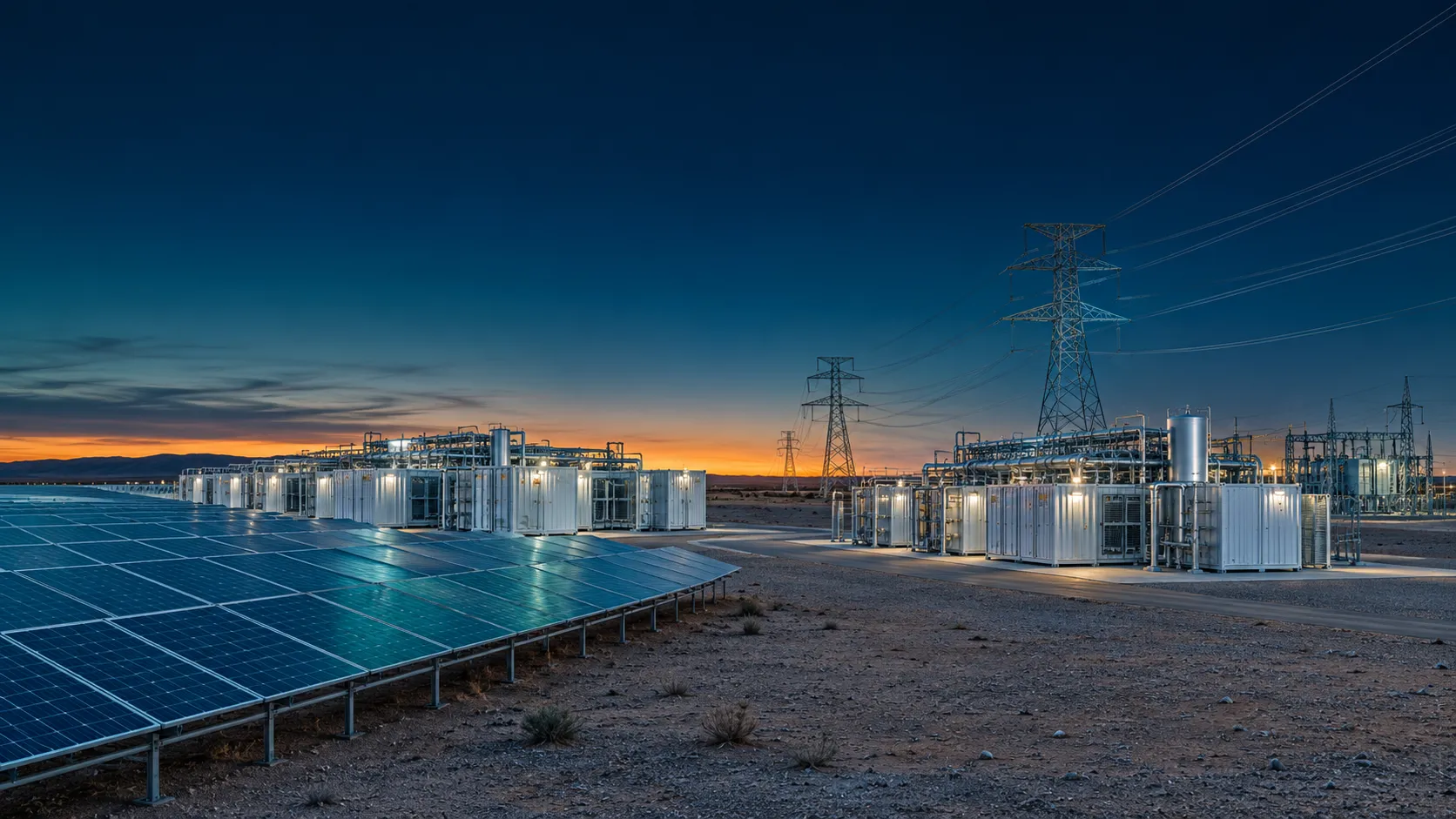
In early November, China Coal Pingshuo topped out the electrolysis building of its 600 MW off-grid solar hydrogen project in Shuozhou, Shanxi. PV power feeds the electrolyzers directly, and the developer says the design avoids "large-capacity energy storage facilities" (Shanghai Metals Market) [1].
In Rotterdam, Shell made the opposite call. Its 200 MW Holland Hydrogen 1 electrolyzer is grid-connected and matched monthly to the 759 MW Hollandse Kust Noord offshore wind farm (S&P Global) [2].
Both choices are rational. The off-grid vs grid-connected green hydrogen decision sets your electrolyzer utilization, your electrical design, your permitting path and your route to RFNBO certification. It is made early, often in pre-feasibility, and it is expensive to reverse. This article sets out the trade-offs in plain terms, with the numbers behind them.
Three architectures, not two
Most projects fall into one of three configurations:
| Configuration | Power supply | Typical examples |
|---|---|---|
| Islanded (fully off-grid) | Dedicated wind and/or solar, often with a battery, no utility connection | ChinaCoal Pingshuo (China), Samsung C&T Gimcheon (Korea), Hydrogen Dune (Namibia) |
| Directly connected with grid backup | Dedicated renewables plus a grid connection for firming or auxiliaries | Hybrid designs under study for many export projects |
| Grid-connected via PPAs | Grid electricity, with renewable attributes contracted through power purchase agreements | Holland Hydrogen 1 (Netherlands) |
Off-grid projects are no longer only pilots. Samsung C&T completed Korea's first off-grid facility in March: 8.3 MW of PV powering 10 MW of electrolysis, producing about 0.6 tonnes of hydrogen per day (Samsung C&T) [3]. In Spain, H2Pro and Doral Hydrogen signed for a 5 MW unit fed DC-to-DC by 10 MWp of solar in Extremadura, with plans for up to 50 MW of electrolysis and 80 MWp of PV (PR Newswire) [4].
Capacity factor: what the grid buys you
The grid's main economic gift is utilization. An islanded electrolyzer can only run when its own renewables produce. Wood notes that wind and solar PV typically have capacity factors "below 50%" (Wood) [5].
That ceiling matters because CAPEX is spread over fewer kilograms. A 2025 review of off-grid techno-economic tools collects the evidence (Fernandes et al., Hydrogen) [6]:
- Raising the renewable capacity factor from 15% to 30% cut LCOH by about 50% in one study it cites.
- A wind capacity factor of about 50% in Patagonia versus 25% in Italy was a key reason for an LCOH of €8.6/kg versus €12.46/kg in another.
- The same review found that seven TEA tools gave LCOH estimates from €5.86/kg to €8.71/kg for one standardized off-grid case, a 49% spread. Your tool choice is itself a source of uncertainty.
Grid access lifts output, but only while grid power is cheap. A 2026 study of a 60 MW wind farm in Newfoundland found that zero grid capacity gave the highest LCOH and the lowest hydrogen output. Above a grid price of about 80.5 CAD/MWh, though, the optimal electrolyzer-to-wind capacity ratio fell from about 1.0 to about 0.4 (Radwan and Pope, IJHE) [7].
Grid dependency can also push costs up. A 2026 study of a 24 MW grid-supported PV-wind system reported an LCOH of €3.2/kg in its PV-dominant, low-output case, rising to as much as €17/kg at higher production levels as grid use increased (Devrim and Eryılmaz, IJHE) [8].
The lesson: the grid is a utilization tool, not a free lunch. Electricity accounts for 70–80% of levelised production cost, according to UK utility executives quoted by Argus [9]. For the off-grid side of this trade-off, see our pieces on electrolyzer capacity factor and LCOH and hybrid solar-wind coupling.
Off-grid's hidden bill: keeping the island stable
A utility grid holds voltage and frequency for you. An island must do it alone, with almost no rotating mass. Wood's analysis lists what that takes (Wood) [5]:
- Grid-forming inverters that set the island's voltage and frequency, so grid-following inverters can synchronize to them.
- Inertia, real or synthetic. Inverter-based wind and solar add no mechanical inertia, so frequency falls faster after a generation loss. Synthetic inertia from batteries responds "within 50ms to 1s", and some true inertia is usually still needed.
- Fault current. Inverters inject far less fault current than synchronous machines, which makes faults harder to detect. Synchronous condensers are "one of the most common pieces of equipment to improve short circuit levels"; STATCOMs support voltage.
- Scale. Most off-grid systems built so far have been microgrids, defined by CERTS as "less than 500 kW". Gigawatt-scale islands need features of both microgrids and utility grids.
The cost of that stability can be quantified. A 2025 study modelled a 5 MW electrolyzer on 5 MW of PV and asked how much energy storage, as a share of total system power, kept the island stable (Zhou et al., Energies) [10]:
| Grid-forming strategy | Minimum storage ratio | LCOH (CNY/kg) |
|---|---|---|
| Centralized grid-forming BESS | 36% | 33.212 |
| Grid-forming electrolyzer with supplemental storage | 20% | 29.750 |
| Composite multi-source coordination | 16% | 25.458 |
The control strategy moved LCOH by about 23% in that case. The centralized battery also needed about five replacements over a 20-year life. The authors note that the cheapest option asks more of the converters and the controls.
Real projects show the same pattern. Hydrogen Dune in Walvis Bay, Namibia, runs a 5 MW PEM electrolyzer with a 5.9 MWh battery, fully independent of a national grid of about 700 MW. Its energy management system uses solar forecasts to plan production and auxiliary loads several days ahead (TaiyangNews) [11]. We covered battery sizing in detail in battery storage for green hydrogen.
Grid-connected's hidden bill: queues and rules
A grid connection solves stability and utilization, then adds two new risks.
Connection timing. At Hydrogen UK's conference in March, RWE called UK grid connection dates "very uncertain" and warned that slips could affect eligibility for the second Hydrogen Allocation Round. Statkraft added that "hidden electrical infrastructure costs" offset savings from co-located designs. The same report notes that even with a 5:1 wind-to-electrolyzer ratio, electrolyzers would still draw grid power 33% of the time (Argus) [9].
RFNBO compliance. If the product is sold into the EU as renewable hydrogen, grid electricity must pass the tests of Delegated Regulation (EU) 2023/1184. As summarized by Stibbe [12]:
- Direct connection to a renewable installation is its own pathway.
- Grid electricity counts as fully renewable in a bidding zone where the renewable share exceeded 90% in the previous calendar year. As of 2023, only bidding zones in Sweden qualified.
- Low-carbon grids below 18 gCO2eq/MJ qualify if the producer holds a renewable PPA and meets the correlation rules.
- Otherwise, additionality applies: PPAs with renewable capacity that came into operation no more than 36 months before the electrolyzer, without operating or investment aid.
- Temporal correlation is monthly until 31 December 2029, then hourly from 1 January 2030.
- Geographic correlation requires the same bidding zone, or an interconnected zone with comparable market conditions.
Holland Hydrogen 1 shows how timing interacts with these rules: starting operation by the end of 2026 brings a 10-year exemption from additionality (S&P Global) [2]. Our explainer on RFNBO additionality rules covers the details.
Those rules are under review. In April the Commission said it would propose a targeted review before the end of June. On 14 July, Céline Gauer, the Commission's director-general for energy, told the European Parliament's industry committee it would come "very shortly in the autumn" (Argus) [13]. Analysts at Capstone expect hourly matching to slip to 2032–2033, though that is a forecast, not a decision (Capstone DC) [14].
Don't bank on relaxation rescuing a weak grid case. A September 2026 study for EDF Europe found that relaxing additionality and temporal correlation would cut LCOH by only about €0.10–0.25/kg in the short term, while adding more than 15 Mt of greenhouse gas emissions in the EU in 2035 (EDF Europe) [15]. For the state of play, see RFNBO delegated act revision 2026.
Five questions that decide it
Use these early, before the single-line diagram is drawn.
| Question | Points to off-grid | Points to grid-connected |
|---|---|---|
| How good is the renewable resource? | High, complementary wind and solar | Weak or single-source resource |
| Can you get a grid connection on time? | Long queue, high connection cost | Firm date, reasonable tariffs |
| What does the offtaker need? | Flexible demand or buffer storage on site | Steady baseload with little storage |
| Where is the product sold? | EU RFNBO markets, where direct connection simplifies proof | Domestic markets, or a grid that qualifies as renewable or low-carbon |
| What does grid power cost? | High or volatile prices | Low prices in many hours |
Three practical points follow:
- Model both cases early. The difference shows up in electrolyzer sizing, storage and electrical design, not just in the power price line.
- Price stability in from day one. Off-grid stability equipment (grid-forming capacity, storage, fault-current support) belongs in the pre-feasibility CAPEX, not in a later FEED surprise.
- Track the rulebook. For EU-bound volumes, the pathway you choose sets your certification evidence. A revised delegated act could change the grid-connected case; the direct-connection case is less exposed. Our guides to site selection and offtake agreement structure cover the related decisions.
The bottom line
Off-grid buys regulatory simplicity and freedom from connection queues, and pays for it in utilization and electrical complexity. Grid-connected buys utilization and stability, and pays for it in power prices, queue risk and compliance work. Neither wins by default. The right answer depends on the site's resource, the local grid and where the molecules are sold.
Hyzen's platform already models renewable input, electrolyzer sizing, water, gas conditioning, compression, storage and RFNBO checks. We are building the electrical balance-of-plant and full LCOH modules next. To test a site in minutes, start with our free Site Screener.
Editorial Notes
The RFNBO rule summary follows Stibbe's May 2026 reading of Delegated Regulation (EU) 2023/1184; check the official text for project-specific decisions. The grid-forming storage ratios come from one modelled 5 MW case and should not be read as general sizing rules. At the time of writing, the Commission's targeted review of the delegated act had not been published.
References
[1] Shanghai Metals Market. ChinaCoal Pingshuo 600,000 kW Off-Grid Hydrogen Production Project Tops Out Its Plant. SMM (2026).
[2] S&P Global Commodity Insights. Shell readies Europe's largest refinery for green hydrogen. S&P Global (2026).
[3] Samsung C&T. Samsung C&T Completes Korea's First Off-Grid Green Hydrogen Facility. Samsung C&T Newsroom (2026).
[4] H2Pro and Doral Hydrogen. H2Pro and Doral Hydrogen Partner on World's First Entirely Off-Grid Solar-to-Hydrogen Project for Gas Grid Blending in Spain. PR Newswire (2026).
[5] Wood. Green hydrogen: mitigating electrical instability in off-grid networks. Wood plc.
[6] Fernandes, L., Machado, F., Marcon, L., Fonseca, A. Unified Case Study Analysis of Techno-Economic Tools to Study the Viability of Off-Grid Hydrogen Production Plants. Hydrogen 6(3), 72 (2025).
[7] Radwan, H.M., Pope, K. Hydrogen from wind power: Comparative assessment of scheduling strategies and capacity design for electrolysis systems. International Journal of Hydrogen Energy 249, 155950 (2026).
[8] Devrim, Y., Eryılmaz, S. Comprehensive techno-economic, reliability, and environmental assessment of grid-supported hybrid PV–wind systems for hydrogen production. International Journal of Hydrogen Energy 259, 156585 (2026).
[9] Argus. UK's grid, offtake risks threaten H2 FIDs: utilities. Argus Media (2026).
[10] Zhou, L., Zhang, N., Zhou, Y., Qiu, Y., Chen, S. Quantifying Grid-Forming Requirement for Electrolyzer-Based Hydrogen Production in Off-Grid Systems. Energies 18(24), 6440 (2025).
[11] TaiyangNews. Namibian Off-Grid Green Hydrogen Plant Named The smarter E AWARD 2026 Finalist. TaiyangNews (2026).
[12] Stibbe. Renewable hydrogen in the EU: a framework under pressure. Stibbe (2026).
[13] Argus. EU plans for RFNBO definition review slip to autumn. Argus Media (2026).
[14] Bucchioni, C. The European Commission's Hydrogen Pivot. Capstone DC (2026).
[15] Environmental Defense Fund Europe. New study finds relaxing EU renewable hydrogen rules could raise electricity prices and emissions without delivering significant production boost. EDF Europe (2026).