
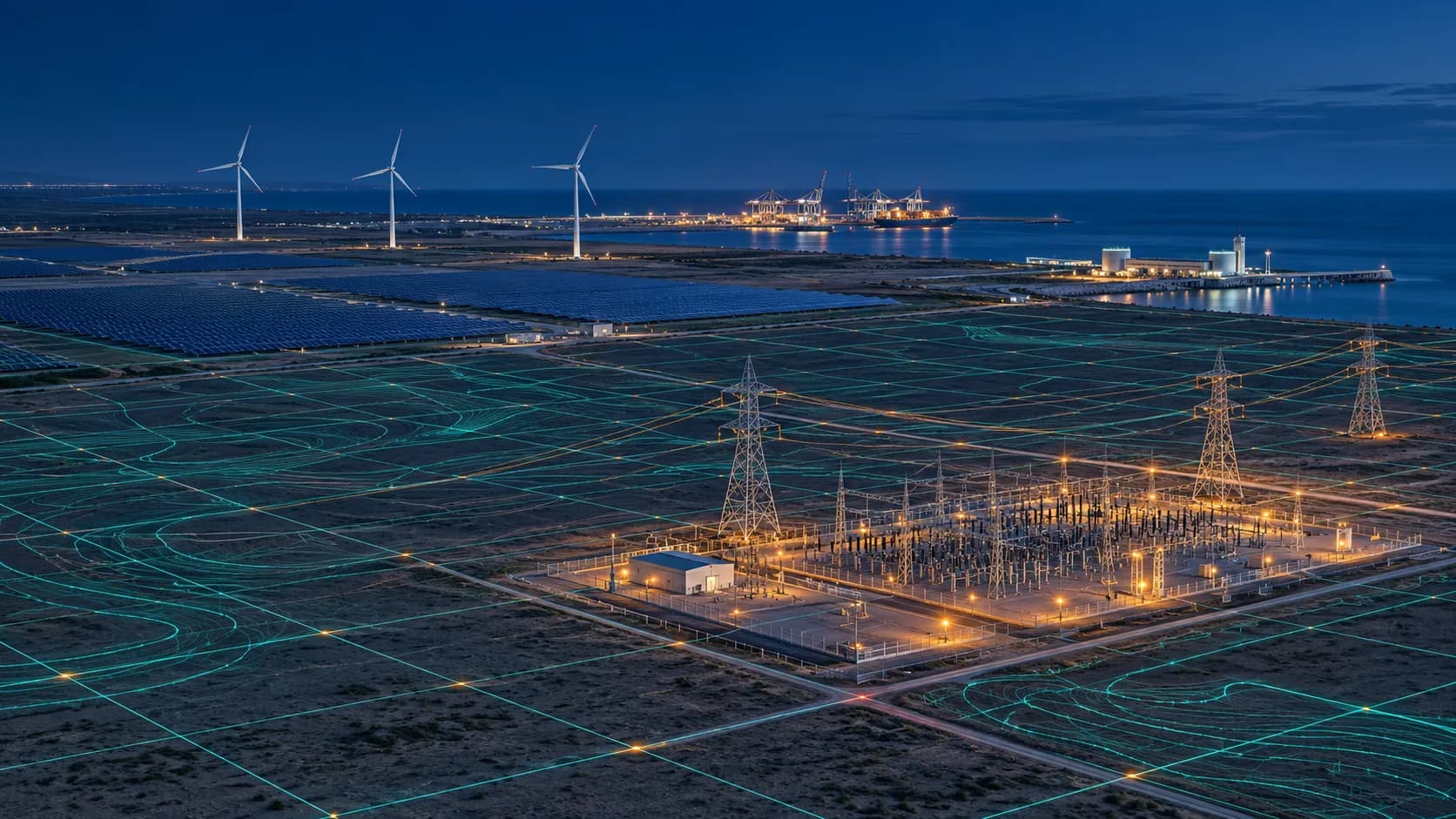
In October 2026, EWE and VERBUND formed a joint venture for one of Europe's largest hydrogen projects: an electrolyzer of up to 500 MW in Nordenham, Germany, producing about 50,000 tonnes a year from 2032. The announcement said little about stacks. It led with the site: land "secured for the long term", "a high-capacity 380-kV grid connection—with potential for expansion into the gigawatt range", the future core hydrogen network next door, cavern storage, "a guaranteed water supply" and existing industrial infrastructure.
Days later, Moeve started the $1.2 billion first phase of its Andalusian Green Hydrogen Valley in Spain: 300 MW of electrolysis and about 45,000 tons a year. The phase can grow to 405 MW "depending on grid availability". The limit on growth is the connection, not the electrolyzer.
That is the point of this article. Green hydrogen site selection criteria decide most of a project's cost and risk before any engineering starts. Below are the seven checks to run before you pay for pre-FEED, with the sources and links to go deeper.
Why site screening matters more in 2026
The market is no longer short of announced projects. It is short of investment decisions. The IEA's Global Hydrogen Review 2026 warns that more than 100 GW of announced electrolysis capacity could miss operation by 2030 if investment decisions are not made by the end of 2027. New FIDs fell below 0.8 Mtpa in 2025.
Capital will go to the sites that survive scrutiny. Developers know what comes first. In a JRC survey of 26 people involved in EU hydrogen projects, availability and cost of renewable electricity ranked first among site-selection factors, and water availability ranked sixth. Low-ranked factors still stop projects. We covered that pattern in why green hydrogen projects get cancelled.
How researchers screen sites, and why the weights matter
Academic site selection uses multi-criteria analysis on GIS layers. A 2026 review in Hydrogen by Kyoto University researchers pulled about 248 indicators from 32 studies and grouped them into five criteria: economic, environmental, technical, social, and risk and safety. Hard exclusions come first: land use, water bodies, waterways, roads, railways, power lines and their buffer zones.
The weighting is where results diverge. In one of the review's scenarios, resource potential carries 34% of the weight. In another, it carries 14%. Only 13 of the 32 studies disclosed their weights at all. Two teams can screen the same region and shortlist different sites.
The same applies at national scale. WRI India's 2026 hub study uses a two-stage GIS method that first ranks states, then finds hub locations within a state. It covers renewable energy, transmission, water, hydrogen demand from fertilizer, refinery and steel, enabling infrastructure and environmental constraints. Its authors note it "does not yet account for economic feasibility or social constraints related to land and water".
For a developer, the lesson is practical. Use a GIS map to find candidates. Then run each candidate through engineering checks, in a fixed order, with your assumptions written down.
Check 1: Renewable resource and capacity factor
The renewable resource sets your electricity cost and your electrolyzer capacity factor. Those two numbers are among the main drivers of LCOH. Screen on an hourly (8,760-hour) profile, not an annual yield: two sites with the same annual output can run an electrolyzer very differently.
Test a solar-only, wind-only and hybrid supply at each candidate. Hybrids often lift the capacity factor at strong sites. See our analysis of hybrid solar-wind capacity factor for hydrogen and how capacity factor drives LCOH. Moeve's first phase, for example, pairs the electrolyzers with a dedicated solar PV plant.
Check 2: Grid connection and the RFNBO route
The grid is both a supply and a constraint. Nordenham's 380-kV connection is a selling point. In Andalusia, grid availability caps the expansion. Ask the operator early about capacity, queue position and timeline.
If you sell into the EU, the connection also decides your compliance route. Under Delegated Regulation (EU) 2023/1184, as currently written:
- grid power counts as fully renewable in a bidding zone where the average renewable share exceeded 90%, with capped production hours;
- temporal correlation is treated as met in any hour when the day-ahead price is at or below €20/MWh, or below 0.36 times the EU ETS allowance price;
- new renewable plants must have come into operation no earlier than 36 months before the electrolyzer.
These rules are under review. Read our RFNBO additionality explainer and the 2026 delegated act revision before you lock a sourcing plan. An off-grid design avoids grid rules but needs buffering; see battery storage for green hydrogen.
Check 3: Water source and basin stress
Electrolysis needs 9 litres of water per kilogram of hydrogen by chemistry, and a cumulative 20–30 L/kg once purification and cooling are included. The site question is not the national average but the local basin, aquifer or coastal intake.
Screen three things: the source (fresh, brackish, seawater or treated wastewater), the cooling concept, and where the reject stream goes. Our guide to green hydrogen water consumption per kg gives a site-level checklist.
Check 4: Land, layout and exclusions
Large PtX projects need large, contiguous land. Oman shows the scale: Hydrom's third land round offered a block of up to 300 square kilometres in Duqm, with proposals required to cover at least 100 square kilometres, plus access to common-use infrastructure.
At screening, check tenure, slope and terrain, protected areas, and buffers to roads, railways, power lines and water bodies. Then check whether the plant, renewables and any export line fit on the plot. Nordenham's long-term land security was listed as a strength for a reason: land problems surface late and cost months.
Check 5: Offtake, pipelines, storage and ports
A molecule needs a buyer and a route. Nordenham sits next to Germany's future hydrogen core network and has access to underground hydrogen storage. WRI India weights demand from fertilizer, refinery and steel plants because nearby demand cuts transport cost and risk.
For export projects, distance to a port and the carrier (ammonia, methanol or compressed hydrogen) change the delivered cost. See our pieces on the export corridor to Europe, offtake agreement structure and green ammonia LCOA methodology.
Check 6: Natural hazards and climate risk
Risk is often scored last and weighted least. In the Kyoto review's criteria-level scenario, distance to water bodies and natural disaster risk each carry 20% of the weight. Check flood zones, seismic risk, sand and dust exposure, and extreme heat. Heat matters twice: it affects equipment ratings and cooling water demand.
Check 7: Permits and social licence
Land and water use need local consent, not only a permit. WRI India flags social constraints on land and water as a gap in its own method. Map stakeholders, existing land users and competing water users before the first site visit. Early engagement with local authorities is cheaper than a redesign.
A screening sequence before pre-FEED
Run the checks in this order. Each one can eliminate a site before the next one costs money.
- Exclusions. Remove protected, unsuitable or unavailable land.
- Resource. Build an 8,760-hour profile and estimate the electrolyzer capacity factor for solar, wind and hybrid supply.
- Grid and compliance. Confirm connection capacity and timing, and the RFNBO route if you sell into the EU.
- Water. Pick a source, a cooling concept and a reject-stream plan.
- Land and layout. Confirm tenure and that the plant fits the plot.
- Offtake and logistics. Name the buyer, the route and the carrier.
- Risk and social licence. Score hazards and map stakeholders.
Only then build the cost model. The site's resource sets one half of LCOH; finance sets the other, as we showed in electrolyzer CAPEX vs discount rate. A site that fails a check at this stage costs a few days. The same failure found in FEED costs months.
Conclusion: screen before you spend
Nordenham and Andalusia show what a strong site looks like on paper: secured land, a large grid connection, water, storage and buyers nearby. Most candidate sites fail at least one of those tests. The aim of screening is to find out which one, early and cheaply.
Hyzen's platform models renewable input on an hourly profile, electrolyzer sizing, water, gas conditioning, compression and storage, and checks RFNBO compliance. We are building the full LCOH and techno-economic engine on top of it. Start with the free Site Screener to test a location before you commission a study.
References
[1] chemeurope.com. EWE and VERBUND establish a joint venture for one of Europe's largest hydrogen projects. chemeurope.com (2026).
[2] Enerdata. EWE and Verbund launch JV for 500 MW hydrogen project in Germany. Enerdata (2026).
[3] ENR. Green hydrogen project set to be Europe's largest starts $1.2B first phase. ENR (2026).
[4] International Energy Agency. Global Hydrogen Review 2026: Production. IEA (2026).
[5] Smart Water Magazine. Most European hydrogen plants will add little pressure on local water, JRC study finds. Smart Water Magazine (2026).
[6] Moe Thiri Zun, Benjamin Craig McLellan. Where in the World Should We Produce Green Hydrogen? An Objective First-Pass Site Selection. Hydrogen 7(1), 11 (2026).
[7] WRI India. Site Suitability Assessment of Green Hydrogen Hubs in India: A Data-driven Methodology for Strategic Hub Development. WRI India (2026).
[8] European Commission. Commission Delegated Regulation (EU) 2023/1184. Official Journal of the European Union (2023).
[9] RMI. Hydrogen Reality Check: Distilling Green Hydrogen's Water Consumption. RMI (2023).
[10] Hydrogen Central. Hydrom advances Oman's green hydrogen strategy with launch of third auction round for lands in Duqm. Hydrogen Central (2025).